

In the world of cryptocurrency investing, not all analysis tools are created equal. The difference between a platform that shows you price charts and one that genuinely evaluates project quality can mean the difference between a sound investment and a total loss. Cryptoscores belongs firmly in the second category—built around a rigorous, multi-dimensional scoring methodology that goes far beyond surface-level metrics.
This article breaks down exactly how cryptoscores evaluates blockchain projects, what indicators it uses, and why this approach represents a significant advancement over traditional crypto analysis methods.
The foundation: more than 100 metrics across 8 categories
Cryptoscores doesn’t rely on a single measure or a handful of indicators to assess a cryptocurrency. Instead, it processes over 100 individual metrics, organized into 8 distinct categories. Each category evaluates a specific dimension of a project’s quality, and together they form a comprehensive picture that no single metric could provide on its own.
Category 1: alerts
The alerts category monitors unusual on-chain and off-chain activity. This includes sudden spikes in large wallet movements, abnormal transaction volumes, and signals that typically precede significant market movements. The goal is to surface actionable intelligence before the broader market reacts.
Category 2: community
Community strength is a reliable predictor of long-term viability. Cryptoscores measures growth rates, sentiment trends, and engagement quality. A project with a declining or disengaged community is a significant red flag, regardless of its technical claims.
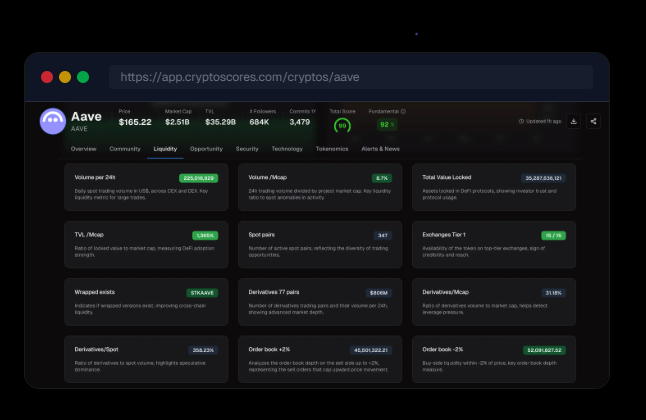
Category 3: liquidity
Liquidity determines whether you can exit a position without significant slippage. We evaluate trading volume, total value locked (tvl) for defi, and active address counts. Low liquidity can trap investors in positions they cannot exit profitably.
Category 4: opportunity
The opportunity score analyzes real-time buying and selling behavior. It identifies who is accumulating and who is distributing, helping investors avoid entering at the peak of a distribution phase.
Category 5: security
Security is non-negotiable. Cryptoscores evaluates professional audits, identified vulnerabilities, and current risk profiles. Given the frequency of exploits in defi, this category is essential for preventing catastrophic capital loss.
Category 6: technology
Genuine innovation is rare. We assess code quality through github metrics, development velocity, and innovation indicators. Projects that invest consistently in their technology are generally more resilient.
Category 7: tokenomics
We examine inflation rates, distribution models, vesting schedules, and token utility. Poor tokenomics—such as excessive inflation or highly concentrated holdings—create persistent sell pressure that undermines price performance.
Category 8: news
Cryptoscores analyzes the structural impact of news on a project’s fundamentals. We distinguish between « noise » and developments that genuinely move the needle for a project’s valuation.
The dynamic total score: synthesizing 100+ metrics into one number
The output of this exhaustive analysis is the dynamic total score—a single, continuously updated number reflecting the overall quality of a cryptocurrency project.
What makes this score « dynamic » is its responsiveness to real-time data. If a security vulnerability is discovered or a « whale » starts accumulating, the score updates immediately. This ensures the user is looking at the current reality of the asset, not a stale snapshot.
Data sources: the foundation of reliable scoring
A scoring methodology is only as reliable as its underlying data. Cryptoscores aggregates data from the most trusted sources in the industry, ensuring total objectivity:
- Market & defi: Coingecko, cryptorank, defillama, dropstab.
- On-chain & social: Artemis, chainlink, lunarcrush, google trends.
- Tech & security: Github, de.fi, tokenmetrics, tradingview.
How this methodology differs from competitors
Traditional platforms present raw market data: price, volume, and market cap. They describe what the market is doing. Cryptoscores goes a layer deeper, asking how a project is performing fundamentally.
Market activity can be manipulated through wash trading or artificial hype. However, on-chain fundamentals, developer activity, and security audits are much harder to fake. This focus on « hard » metrics is what provides cryptoscores users with a competitive edge.
Transparency through education
Cryptoscores publishes a comprehensive gitbook that explains the methodology behind every score. Users can learn which metrics are tracked, why they matter, and how to interpret them in the context of an investment decision. This level of transparency reflects a genuine commitment to user education rather than « black-box » scoring.
A methodology built for serious investors
The cryptoscores methodology represents a significant evolution in crypto analysis. By combining on-chain data, fundamental analysis, security evaluation, and tokenomics into a unified framework, it delivers institutional-grade evaluation to the individual investor.
Explore the full methodology at www.cryptoscores.com and start evaluating cryptocurrencies with professional confidence.